Spandex and elastane are alternate generic names
The FTC’s textile labeling guide explains that ISO uses elastane for the fibre called spandex and permits either name in the context described by that guidance. Seeing the two words on different supplier documents does not, by itself, establish two different fibre types or quality grades.
Generic names also differ from trademarks. A generic fibre description identifies a category; a branded fibre claim concerns a particular commercial identity. Do not substitute a brand name because a specification says spandex or elastane. A branded-material requirement belongs as a separate, explicit item in the purchasing specification.
The US generic definition of spandex describes a manufactured fibre containing at least 85% segmented polyurethane in its fibre-forming substance. That definition concerns the elastic fibre itself. It does not mean the finished fabric contains 85% spandex, and it does not state that the fabric stretches by 85%. These are three different uses of a percentage.
Read the percentage as part of the fabric blend
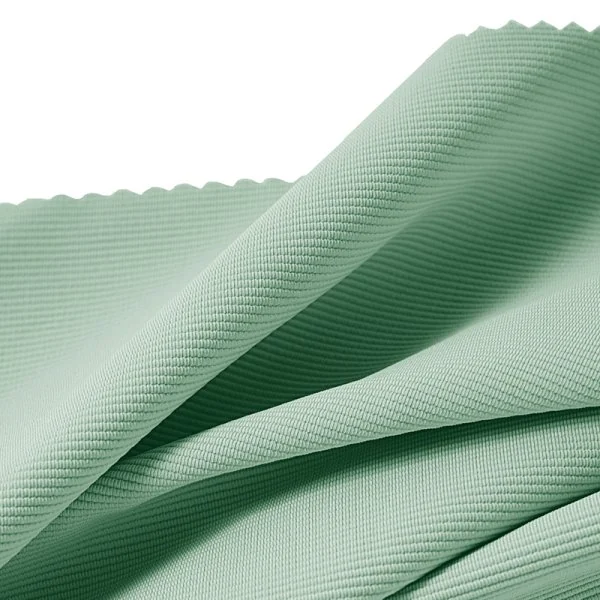
A blend line describes the constituent fibres of the fabric. Hongli article 6602 is recorded as 80% nylon and 20% spandex, with a stated width of 160 cm. In a terminology discussion, elastane refers to the elastic-fibre name corresponding to spandex; changing that word is not evidence of a new fabric development.
Keep the actual article description intact when comparing paperwork. If a sample label and a quotation use alternate generic names, reconcile the article number, composition and other specification fields together. Do not assume that every 80/20 nylon blend is article 6602, or that matching percentages mean two cuttings are interchangeable.
| Information on the document | What it describes | What it does not establish |
|---|---|---|
| Spandex or elastane | Alternate generic naming for the elastic fibre | A quality ranking between two separate fibre categories |
| 20% spandex in an 80/20 blend | The stated elastic-fibre proportion in that fabric | 20% finished-fabric extension or a recovery result |
| At least 85% in the generic fibre definition | The fibre-forming substance described by the definition | The spandex content of a completed fabric |
| Article number | The supplied material’s identity | Permission to replace it with any matching blend |
This distinction is useful when a range includes several elastic blends. It lets the buyer compare the real specifications without creating a false product difference from terminology alone.
Separate fibre names from construction and stretch
Composition, knit construction and finished stretch belong in separate fields. Nylon-spandex identifies a blend family, not the precise construction of every fabric in that family. Likewise, “double-face” should remain the supplied description until a more specific construction is established; the elastic-fibre name does not resolve that question.
Intertek’s overview of stretch and recovery distinguishes crosswise extension from extension in both crosswise and lengthwise directions. It also separates stretch from recovery and remaining growth. A meaningful comparison records the direction and evaluation method, rather than treating a two-way or four-way label as a complete numerical specification.
For garment development, decide which movement matters at each panel. Then compare candidate cuttings in the identified directions and follow with the appropriate garment review. A percentage cannot tell the pattern maker how much extension occurs under a chosen load or how much growth remains afterward. Do not rank two candidates simply by selecting the one with more spandex.
When the base fibre also changes, there is another comparison to make. Our nylon and polyester fabric guide uses two real Hongli blends to show why main fibre, elastic-fibre proportion and finished material need to be considered together.
Reconcile a supplier specification with a sample label
Put the sample label beside the specification and check identity first. An article number and color reference give the review a clear subject. Follow with the complete blend, supplied construction description, width and weight with its unit. A document headed “elastane fabric” is too broad to identify a particular cutting.
Where terminology differs, annotate the correspondence while keeping the original wording available. A useful note might read “elastic fibre described as spandex on this specification; elastane on the comparison sheet.” This makes the reason for the difference visible without quietly changing the underlying product.
Resolve commercial requirements separately: exact color, required material identity and agreed evaluation criteria belong in the order specification. If an application requires specialist labeling review, obtain that review for the actual product and destination. This terminology guide explains fibre names; it does not approve a finished garment label or provide a compliance assurance.
The same discipline applies to numerical fields. A bare weight figure is not enough to establish mass per area. Use the fabric GSM guide when reconciling grams, area and length units, rather than filling in an assumed unit on the comparison sheet.
Compare fabric cuttings before specifying the garment
Use the resolved identity to organize the physical review. Place each cutting with its article and color label, then note face and reverse appearance, hand and drape. Record any directional comparison separately so the observations can be repeated on the same material orientation.
Next, connect an observation to a garment decision. For a close-fitting style, the development review might examine panel movement, seam placement and fit after the chosen care trial. Define those tasks for the intended garment; they are not automatic benefits of the word elastane. Retain the reviewed garment version with the fabric reference so later substitutions have a clear comparison point.
Hongli’s nylon-spandex collection is a starting point for selecting actual articles. Shortlist on the complete specification and project needs. Once the material is selected, keep the same generic naming convention across the working brief while preserving the supplier’s article identity. The purchasing decision should concern the fabric that reaches the cutting table, not which of two alternate fibre names sounded more technical.
Questions about spandex and elastane
These answers keep terminology separate from garment suitability. They apply to choosing and describing apparel fabric, with performance evaluated on the actual material.
What is spandex used for?
Spandex is an elastic fibre used in fabric blends for apparel applications where extension and recovery are relevant to the design. For example, Hongli article 6602 combines nylon and spandex as a candidate for fitted apparel development. Its blend identifies the constituents; the intended garment still needs a suitable construction, directional evaluation and fit review.
What are the downsides of using elastane fabric?
The purchasing risk is choosing an elastic blend from its fibre name or percentage alone. Define the intended care routine, required recovery and other durability criteria for the actual garment, then evaluate the candidate fabric against them. The word elastane does not establish that a fabric will meet those requirements, nor does it prove a universal defect or health concern.
Are spandex and elastane different quality grades?
No quality ranking follows from these two generic names. The FTC explains that elastane is the ISO name for spandex. Compare article identity, the complete blend, construction and agreed finished-fabric results to assess the actual candidates. A brand claim, where required, is a separate specification item and should not be inferred from either generic term.
Does more spandex mean more stretch?
A higher blend percentage is not a finished-fabric extension result. Record stretch in the relevant direction with an identified method, and keep recovery or remaining growth separate. A buyer cannot calculate the finished fabric’s extension or fit from the spandex percentage alone.