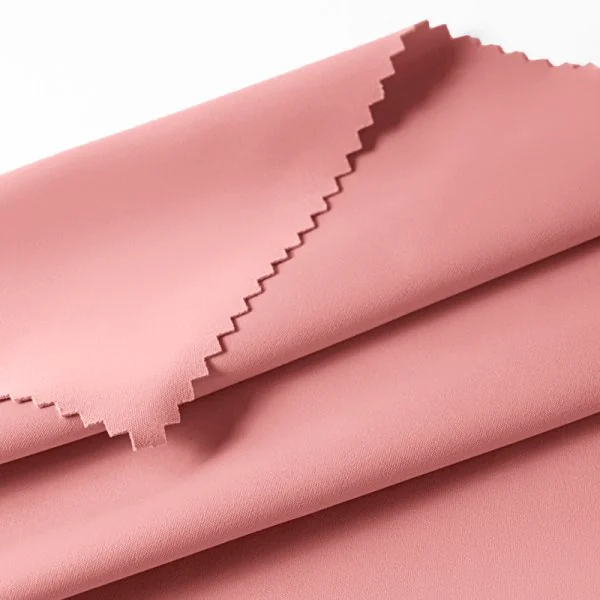
Start with fibre family, blend and construction
Nylon and polyester are different fibre families. The US generic fibre definitions identify nylon as a polyamide and define polyester separately. Spandex is another fibre category. A specification such as 80% nylon and 20% spandex therefore describes a blend, rather than a special name for pure nylon.
Keep three lines separate on the comparison sheet: fibre composition, fabric construction and finished fabric observations. “Polyester” does not identify a knit structure. “Double-face” describes the supplied fabric differently from a fibre percentage; it should not automatically be rewritten as “interlock.” Record the supplier’s exact article description before adding a more specific construction term.
Begin a shortlist with the intended garment and the properties that would change its design. A fitted top may need a different balance of surface appearance, drape and movement from a lined legging. Choose the comparison criteria before handling the swatches, so an attractive color or a familiar fibre name does not become the whole decision.
Compare nylon and polyester for activewear by the same brief
When weighing nylon vs polyester for activewear, keep the garment brief constant. Evaluate each candidate for the same application, lining plan and intended care routine. Describe observations precisely: a smooth face, a firmer handle or visible distortion under a particular extension is more useful than an unexplained “premium” score.
| Comparison item | What to record | How it helps the decision |
|---|---|---|
| Identity | Article number, fibre blend and color reference | Keeps each observation attached to the actual cutting |
| Construction and surface | Supplied construction description; face and reverse appearance | Shows which surface suits the garment and panel placement |
| Hand and drape | A side-by-side description under the same handling conditions | Helps compare the intended silhouette and skin-contact surface |
| Movement | Direction, extension and recovery observations, with the method identified | Separates easy extension from return after extension |
| Fabric dimensions | Width and an explicit fabric-weight unit | Supports later specification and cutting discussions |
A moisture-management claim needs more than a fibre label. The American Chemical Society’s explanation of wicking describes capillary action and the influence of fibre geometry and treatments. Those mechanisms do not establish the drying time or wicking result of a particular Hongli fabric. If liquid handling is a deciding requirement, compare evidence for the actual finished materials under an agreed method.
Nylon vs polyester leggings: assess the complete garment
When comparing nylon vs polyester leggings, a fabric cutting is the first stage. A garment trial can answer different questions: how the panel looks when extended, where a seam sits during movement and whether the selected lining works with the outer material. Treat these as evaluation tasks, not as properties guaranteed by either fibre family.
For an initial trial, use the same pattern and document any changes required by the second fabric. If one candidate needs a different panel shape, compare the revised garment as well as the original version. Otherwise the exercise may rank a pattern mismatch instead of the materials. Check the selected color in the intended construction; a finding on one colorway should not become an unsupported promise for every shade.
Stretch and recovery also deserve separate entries. Intertek’s stretch and recovery overview distinguishes extension directions and recovery behavior. A blend percentage alone does not state the extension reached under a load or the growth remaining afterward. Our spandex and elastane guide explains why a higher elastic-fibre percentage is not a ready-made garment performance score.
Put two real Hongli articles beside the decision
Hongli’s article 6602 and article 5508 provide a practical starting pair. Their recorded specifications establish different blends with the same stated width. They do not isolate fibre type as the only changing variable.
| Recorded detail | Article 6602 | Article 5508 |
|---|---|---|
| Fibre composition | 80% nylon, 20% spandex | 82% polyester, 18% spandex |
| Supplied description | Smooth double-face fabric | Double-face fabric |
| Stated width | 160 cm | 160 cm |
| Useful next comparison | Handle both cuttings against one garment brief, then record the differences that matter to the design | |
The elastic-fibre proportion differs as well as the main fibre. These articles are therefore candidate materials for a buyer’s comparison, not a controlled experiment proving nylon or polyester superior. Keep the article number on the physical cutting, review sheet and subsequent quotation so observations do not migrate between products.
Record the sample comparison before requesting a quotation
Use one short record per candidate: article and color, composition, supplied construction description, dimensions, observed hand and intended garment. Add the decision beside the observation. For example, “the reverse surface suits the proposed inner panel” explains why a swatch remains on the shortlist; “feels good” does not.
Next, separate acceptance requirements from preferences. A preferred hand can guide selection, while a required performance result needs a defined measure and acceptance basis. Where a wear or care trial forms part of development, identify the garment version and conditions. This creates a usable comparison when the range is revisited, rather than a collection of disconnected impressions.
For a broader shortlist, browse nylon-spandex fabrics alongside polyester-spandex fabrics. Reduce that list using the actual project requirements before moving into detailed sample development. When weight appears on a specification, the fabric GSM guide helps distinguish mass per area from other weight descriptions.
Questions about nylon and polyester fabric
The following questions are best answered at fabric level. Fibre terminology helps identify a material; the finished cutting and garment comparison supply the evidence for choosing it.
Is nylon breathable?
The word nylon alone does not establish the airflow of a finished fabric. For an apparel comparison, identify the knit construction and evaluate the actual material, including the lining arrangement where relevant. If breathability is a purchase requirement, define the property and comparison method rather than treating the fibre name as a measured result.
What does nylon feel like?
Handle the actual cutting to answer this for your project. Describe the face and reverse, smoothness, firmness and drape beside the competing fabric. A nylon fibre description does not establish one universal hand for every yarn, knit and finish. Hongli article 6602 can be reviewed as a specific fabric rather than as a proxy for all nylon materials.
Is nylon or polyester better for leggings?
Choose between complete fabric candidates against the intended legging design. Compare the blends, construction, directional stretch and recovery, then review the chosen material in the garment. Articles 6602 and 5508 are different blends, so their percentages cannot establish a universal winner or an identical fit. Record which observations and agreed results support the final choice.